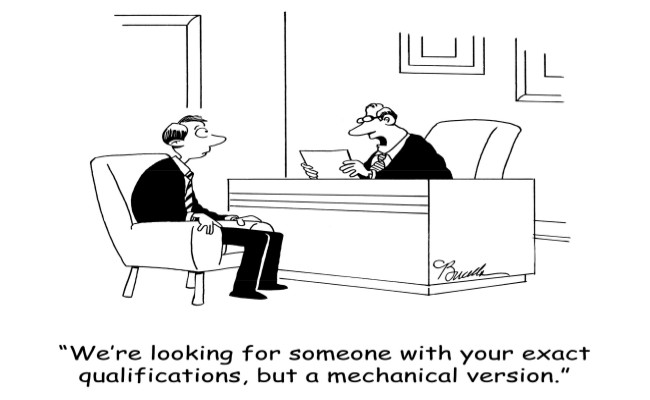
Funny? Yet, an alarming reality!
According to a federal report released in 2016, 9%- 47% of jobs could be lost to Artificial Intelligence (AI) in the foreseeable future! However, this gaping-wide range depicts the uncertainty that still envelopes the concept of leveraging AI.
AI is not yet very clearly understood. Most of today’s leaders are faced with the formidable dilemma of whether AI will be a beneficial or detrimental change, and there is still considerable debate on how machine learning should be defined and regulated. There’s no denying that AI will influence job roles and hiring in a significant manner, but predictions as to what extent are still rather speculative.
“If we look at these statistics in isolation, the hair-raising figure of 47% suggests that talent sourcing partners may become redundant in the future!”
Yes, you will. More than ever!
The OECD’s analysis observes that while jobs will be lost to AI, new job roles will also be created which will add back to the job pool. This is backed up by the WEF (World Economic Forum), who say that 65% of children entering school today will be in jobs that do not exist today. The need of the hour, for job seekers is to redefine their skills to be effective in these new roles.
All of this is going to make the job of recruitment a more profound and discerning activity. Companies are evolving their business models introducing programs to help employees to align with new customer demands. AT&T, for example, realized that nearly half of their current workforce (over 250,000 employees) would become obsolete. They, therefore, like a lot of other organizations (including Google), decided to invest in upskilling, with an investment of over $1 billion.
AI has revolutionized the way we think about recruitment. However, the recruitment industry is not going to be weeded out of the scene – if anything, recruitment is only going to get more competitive, as job roles become more complex in terms of responsibilities as well as required qualifications.
Because an AI tool cannot completely replace a human interaction- yet!
At its core, the job of recruitment begins with deep understanding. This means that the industry, the competitors and the core strategy of the business must be within the thorough grasp of the recruiter. It involves insight into their business partner’s workforce plan through establishing deeper relationships with hiring managers and candidates. Building relationships requires day to day human interactions- this is where your bot can’t replace our execs just yet!
True. Recruitment has now evolved towards a mixed AI-human approach.
A recruiter who looks to harness AI’s capabilities will deliver faster turnaround times, better hires and less attrition. Singapore Business Review claims that AI is all set to revolutionize the recruitment and staffing industry in several ways.
The recruitment industry is already laboring under the obstacles of changing technology, niche skill requirements, and candidate satisfaction. According to the SHRM, the cost of a bad hire could be up to almost a quarter of a million dollars! Added to this, is the pressure to reinvent our hiring process to include AI. Yet, this is what is sure to make a recruiter’s life so much simpler. But to what extent can AI be leveraged to make our lives easier?
A large part of a recruiter’s life is spent on menial and repetitive tasks involving large volumes of data; such as screening applicant profiles, reviewing resumes and setting up initial communication. This is a significant chunk of a recruiter’s time that might have been better spent in building stronger relationships.
AI is eventually going to make decisions, and learn, based on predefined parameters. But for now, AI and human beings will go hand in hand to deliver efficient recruitment.
Certainly not! Investing in AI for recruitment should be your staffing partner’s problem.
The right staffing partner. Remember, the change towards AI is already set in motion. Recruitment firms that do not have an AI strategy will become obsolete. Make sure your partner
The bottom line- AI is coming, and will eventually dominate the scene. But the good news is that you don’t have to worry about making the change. The investments involved, the time lost in changing the process to include our artificially intelligent companions, is where we come in. And we’d love to show you how effortlessly you can sail through this revolution.
That’s OK. We’d be happy to chat with you until you are. Reach out to our recruiting specialists at recruiters@paramountsoft.net!